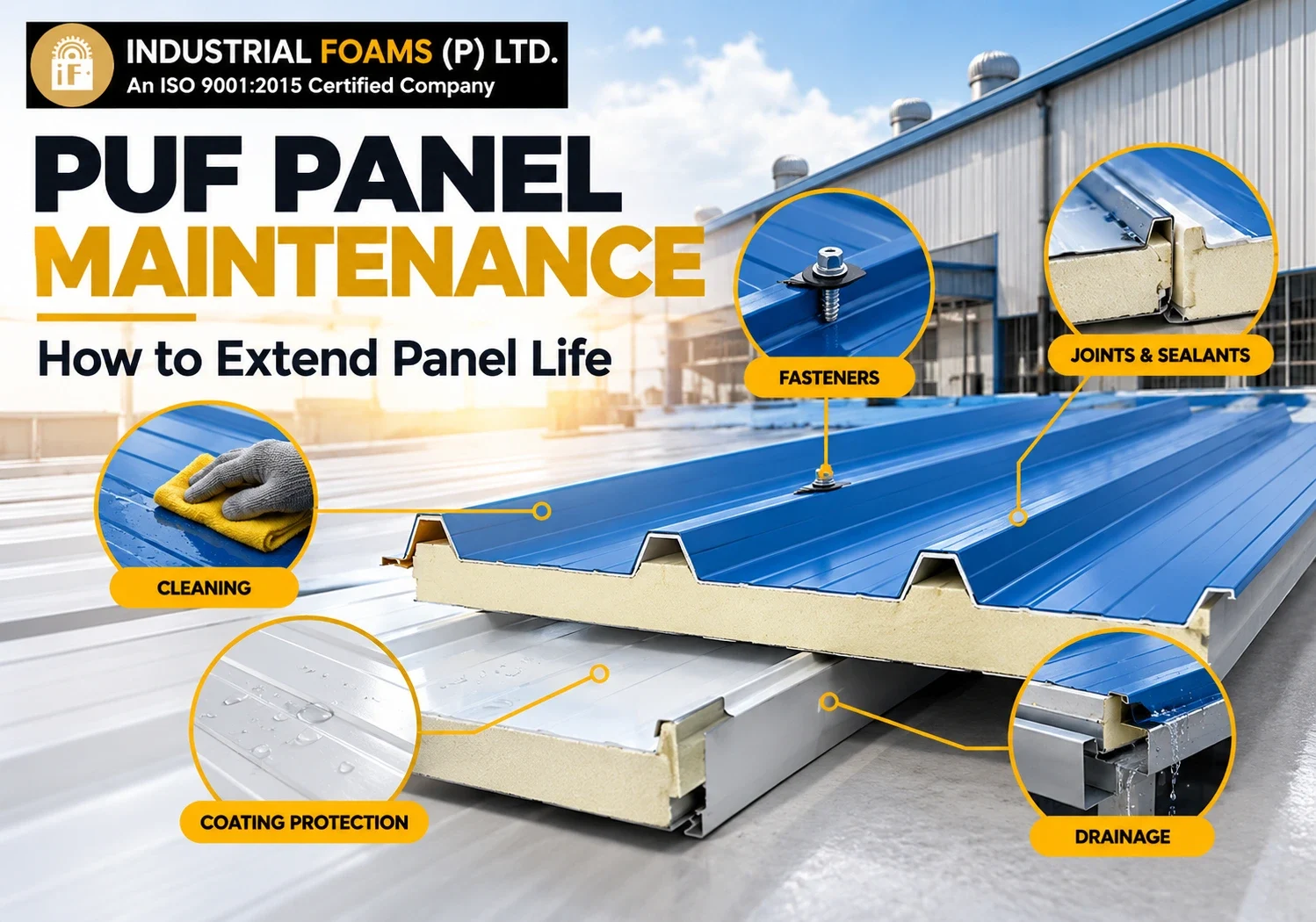
PUF panel maintenance should protect the complete envelope, not just the visible metal skin. A practical plan inspects joints, sealants, fasteners, flashings, gutters, roof penetrations, protective coatings, doors and interfaces with the supporting structure. Small defects should be corrected before water, air leakage, corrosion or impact damage reaches the insulation core.
Service life depends on panel design, installation quality, environment, traffic, cleaning chemicals and maintenance response. There is no universal inspection interval for every building. Establish a documented baseline after installation, inspect routinely and after severe weather or site changes, and follow the panel supplier’s repair guidance for the actual skin, coating, joint and core system.
Understand What Maintenance Is Protecting
A PUF sandwich panel combines metal facings, a rigid polyurethane foam core and formed joint profiles. Performance depends on those layers remaining connected and on the building envelope controlling water, air and heat at panel joints, corners, openings and penetrations. Damage that appears cosmetic may become important when it breaks coating continuity or exposes the core.
Industrial Foams describes a range of PUF panels and insulated solutions for buildings, cold rooms and prefabricated structures. Maintenance instructions should match the supplied product, coating and application. A cold-room panel, external roof panel and internal partition do not face the same moisture, temperature, loading or hygiene conditions.
| Inspection area | Early warning signs | Maintenance response |
|---|---|---|
| Panel skin | Scratches, dents, chalking or rust | Clean, assess and repair coating |
| Joints and sealants | Gaps, cracks or displacement | Renew compatible seals |
| Fasteners | Loose, missing or corroded heads | Investigate cause and replace correctly |
| Flashings | Open laps or damaged edges | Reseal and refix |
| Gutters and drainage | Debris, ponding or overflow | Clear and correct falls |
| Penetrations | Movement or failed weathering | Repair detail and support services |
Create a Handover Baseline
Before occupancy, record panel type, thickness, skin material, coating, colour, joint system, fastener pattern, sealant, flashing details and supplier recommendations. Keep approved drawings, product data, warranties and photographs of completed elevations and roofs. Mark concealed services and restricted walking areas so future work does not damage panels accidentally.
Complete a close-out inspection for dents, coating damage, swarf, loose fasteners, incomplete sealant, blocked drainage and poorly finished penetrations. Record accepted repairs. A strong baseline distinguishes installation defects from later damage and gives maintenance teams the information needed to select compatible cleaners, sealants, coatings and replacement panels.
Set Risk-Based Inspection Intervals
Inspect high-risk zones more often: roof edges, gutters, valleys, penetrations, loading bays, vehicle routes, wash-down areas, high-humidity rooms and locations exposed to chemicals or coastal air. Internal walls in a dry, protected office generally need less attention than external roofing above a corrosive industrial process.
Add event-driven inspections after hail, storms, roof work, equipment installation, impact, leakage or building movement. The maintenance schedule should state who inspects, what access is permitted, how findings are graded and how quickly defects must be closed. Use the same photo locations so gradual coating or joint changes are visible over time.
Clean Panels Without Damaging the Finish
Remove dust, leaves, process deposits and biological growth before they hold moisture or block drainage. Use methods approved for the coating and contamination. Begin with the mildest practical cleaner, soft tools and clean water, and test an inconspicuous area. Avoid uncontrolled pressure washing, abrasive pads and aggressive chemicals that can damage paint or force water into joints.
Work from safer upper areas toward drainage paths and prevent dirty water from entering sensitive production zones. Rinse residues and dry where necessary. Cleaning records should identify product, dilution, contact time and observed condition. Where hygiene is critical, coordinate the method with site sanitation requirements and the panel supplier.
Protect Coatings and Cut Edges
Factory-applied coatings provide important corrosion protection, but scratches, drilled holes and cut edges can expose metal. Remove drilling swarf promptly because particles can rust and stain otherwise sound panels. Assess damage depth and use an approved touch-up or repair system rather than applying an unknown paint that may not adhere or match weathering behaviour.
Investigate recurring corrosion rather than repeatedly painting over it. Possible causes include trapped moisture, chemical vapour, incompatible metals, damaged drainage, poor detailing or coating unsuited to the environment. Widespread blistering, delamination or under-film corrosion needs supplier or coating-specialist assessment and a defined preparation and recoating system.
Maintain Joints Sealants and Flashings
Joints control weather, air leakage and thermal continuity. Inspect for open laps, displaced gaskets, cracked sealant, compression loss and movement around corners or transitions. Replace failed material with a compatible product after cleaning and preparing the surfaces. Adding new sealant over dirt or detached material usually hides rather than solves the defect.
Check ridge, eave, corner, apron and opening flashings for secure laps, edge damage and correct water shedding. Thermal movement must remain possible where the design requires it. Industrial Foams’ color-coated sandwich PUF panel page can support product discussions, but the original project detail should govern repair geometry.
Inspect Fasteners and Supports
Loose or overdriven fasteners can damage washers, distort panels and create leakage paths. Corroded heads may indicate coating damage, incompatible material or a harsh environment. Replace fasteners with the specified type, length, coating and sealing washer, and use controlled installation tools. Do not keep tightening a fastener when the substrate or hole has failed.
Look for panel bowing, local movement, misalignment and vibration. These signs can come from support movement, thermal restraint, impact or load changes. The panel is an envelope component, not a substitute for checking the supporting structure. Escalate structural movement, widespread fastener distress or unexpected deflection to competent engineers.
Keep Roof Drainage Working
Blocked gutters and outlets can cause ponding, overflow and water entry at laps or penetrations. Remove debris, verify falls and inspect joints, outlets and downpipes. Do not allow stored materials, temporary cables or later services to obstruct drainage. Investigate staining below the roof even when an active drip is not visible.
Safe roof access is essential. Define walkways, fall protection and weather limits, and avoid concentrated loads on unsupported panel areas. Where frequent access is expected, provide suitable access paths and working platforms. A maintenance visit should not create more damage than it corrects.
Control Moisture and Condensation
Condensation may result from air leakage, missing vapour control, thermal bridges, high internal humidity or unsuitable operating conditions. Simply wiping water or adding sealant at the visible location may not address the mechanism. Record indoor and outdoor conditions, operating schedules and where moisture appears before deciding on a repair.
Inspect interfaces at floors, roofs, doors, windows and service penetrations. Wet insulation, persistent odour, staining or a change in thermal performance can indicate concealed damage. Use an appropriate investigation method and replace affected material where the core or bond cannot be restored reliably.
Manage Doors Windows and Service Penetrations
Openings concentrate movement and workmanship risk. Check frames, seals, flashings, thresholds, hinges and closers. Confirm that heavy doors or equipment are supported as designed and are not pulling on panel skins. Repair impacts promptly in loading and material-handling zones and consider barriers where repeated contact occurs.
New pipes, ducts, cable trays and rooftop equipment should use engineered supports and weathering details. Do not cut panels until the route, structural support, insulation continuity and fire or hygiene requirements are approved. Document each alteration and update drawings so future inspections include the new interface.
Repair Dents Punctures and Local Damage
Classify damage by location, depth, skin rupture, core exposure, bond condition and effect on joint geometry. A minor superficial dent may need observation, while a puncture or crushed core can compromise water resistance, insulation and stiffness. Temporary patches should be identified and replaced with an approved permanent repair.
Where replacement is required, match panel thickness, profile, joint, skin, coating and thermal requirement. Plan removal so adjacent panels, flashings and services are protected. Industrial Foams states experience with insulated panels and prefabricated solutions on its About Us page provide site photos and original specifications when requesting repair guidance.
Coordinate Fire and Safety Requirements
Maintenance must not alter a fire-rated assembly, compartment line or tested detail without approval. Uncontrolled penetrations, incompatible fillers and missing closures can undermine the intended performance. Keep records of approved systems and inspect fire-stopping or closures at service routes according to the project requirements.
Before hot work, drilling or chemical cleaning, complete site permits and risk controls. Consider concealed services and combustible materials, ventilation and emergency response. Product classification and regulatory requirements are project-specific; request supporting documentation for the installed system rather than relying on a general material description.
Track Thermal and Operational Performance
Rising HVAC energy, uneven temperatures, frost, condensation or longer refrigeration cycles may signal air leakage, wet insulation, failed doors or operational change. Trend energy and temperature data where the facility allows it. Compare findings with occupancy, production and weather rather than assuming the panels are the only cause.
Use targeted thermal imaging or moisture investigation when conditions are suitable and results can be interpreted competently. Confirm suspected defects physically before large-scale replacement. A documented performance trend helps prioritize repairs and provides stronger evidence for warranty or capital-planning discussions.
PUF Panel Maintenance Checklist
- Retain product data, drawings, warranties and the handover condition record.
- Inspect skins, joints, fasteners, flashings and penetrations.
- Clear roofs, gutters, outlets and drainage routes safely.
- Use coating-compatible cleaners, sealants and repair products.
- Remove swarf and treat scratches or exposed edges promptly.
- Investigate condensation, corrosion and recurring leakage causes.
- Control new penetrations and structural or rooftop additions.
- Record photographs, repairs, materials and closure dates.
Common Maintenance Mistakes
Avoid walking anywhere on a roof without an access plan, using aggressive cleaners, painting over corrosion, sealing over wet or dirty joints and fitting incompatible fasteners. Do not leave metal swarf after drilling or assume that every leak begins directly above the visible stain.
The biggest mistake is delaying small repairs until the core or supporting construction is affected. A consistent inspection and documentation routine makes maintenance predictable and protects both thermal performance and appearance.
Plan Maintenance Around Environmental Exposure
Record pollutants, salt, process vapour, wash-down chemicals, dust and prevailing weather for each elevation and roof zone. Exposure can differ sharply across one building. A wall facing a cooling tower or chemical exhaust may need more frequent cleaning and coating inspection than a sheltered wall made from the same panel.
Review the environment whenever production changes. A new exhaust, stored chemical or adjacent process can invalidate the original maintenance assumptions. Ask the panel or coating supplier whether the changed exposure requires a different cleaner, inspection interval or protective system.
Use a Defect Priority System
Grade findings by consequence and urgency. Active water entry, open roof laps, exposed core, unsafe access and widespread corrosion require prompt escalation. Minor dirt or shallow dents may be scheduled, while evidence of structural movement needs engineering review before local cosmetic work proceeds.
Assign every defect an owner, due date and closure evidence. Reinspect critical repairs after rain, wash-down or a temperature cycle. A colour-coded register helps management see overdue risk without treating every mark on a panel as the same priority.
Manage Replacement Panels and Spares
Retain a small quantity of matching panels, flashings, fasteners and approved repair materials where future availability is uncertain. Store panels flat or supported as specified, dry, protected and clearly identified. Long panels and coated sheets can be damaged by poor lifting or condensation inside packaging.
Before ordering replacements, verify current dimensions, joint orientation, profile, thickness, skin gauge, coating and colour. Weathering may make a technically matching new panel look different from the surrounding elevation. Plan visible replacements and colour expectations with the owner.
Coordinate Contractors and Permit Controls
Roofing, HVAC, electrical and fire-system contractors can unintentionally puncture or overload panels. Require approved access routes, cutting methods, service supports, weathering details and housekeeping. Inspect the area before and after third-party work and remove swarf, packaging and temporary fixings.
Use permits for roof access, penetrations, hot work and chemical use. Provide contractors with the installed panel information and prohibit unapproved sealants or screws. Clear controls protect the warranty and make responsibility for later leaks easier to determine.
Prepare an Annual Condition Review
Summarise defects by type, location and trend at least once per maintenance cycle. Compare leakage, corrosion, impact damage, sealant failure, energy indicators and contractor alterations. Use the review to set the next inspection frequency and capital-repair priorities.
Photographic comparison is especially useful for coating changes and recurring joint movement. Include a short budget forecast for cleaning, local repairs and planned replacement. This turns panel care from reactive leak response into a predictable asset-management programme.
Estimate Repair Scope and Budget
Separate routine maintenance, corrective repair and capital replacement. Routine work includes cleaning, drainage and minor seal renewal. Corrective repairs address local coating, flashing, fastener or impact defects. Capital work may be required for widespread corrosion, wet cores, recurring movement or an envelope that no longer suits the operating environment.
Budget using measured quantities and access requirements, not only square-metre panel rates. Include scaffolding or lifting equipment, production protection, dismantling, disposal, flashings, sealants, testing and reinstatement. Clear scope reduces the temptation to accept a cosmetic patch where a complete detail must be rebuilt.
Verify Repairs Before Closing the Work Order
Inspect surface preparation, fasteners, laps, sealant profile, coating coverage and replacement-panel alignment before access is removed. Where appropriate, verify the repair under controlled water testing, operating conditions or a suitable weather event. Use methods that do not create pressure or water paths the assembly was never designed to withstand.
Update drawings and the defect register, attach product details and photographs, and set a follow-up inspection date. Closure should confirm that the underlying cause was addressed, not merely that the visible opening disappeared on the day of repair.
Frequently Asked Questions
1. How often should PUF panels be inspected?
Set intervals according to exposure, use and supplier guidance. Inspect higher-risk roofs, drainage, penetrations and impact zones more frequently and after severe events.
2. Can PUF panels be pressure washed?
Only when the panel and coating supplier approves the pressure, distance, direction and cleaner. High pressure can damage coatings or force water into joints.
3. What causes rust spots on panel surfaces?
Possible causes include scratches, drilling swarf, cut edges, trapped moisture, aggressive deposits or coating damage. Identify the source before repair.
4. Should damaged sealant be covered with new sealant?
Not without removing failed material and preparing the joint. New sealant must be compatible with the existing surfaces and movement requirement.
5. How are small dents repaired?
First assess whether the skin is split, the core is crushed or the joint is affected. Cosmetic and structural damage require different responses.
6. When should a complete panel be replaced?
Replacement may be necessary when the skin is punctured extensively, the core is wet or crushed, bond failure is significant, or joint geometry cannot be restored.
7. Can any paint be used for touch-up?
No. Use a coating system compatible with the factory finish and environment, with the required surface preparation.
8. Why does condensation appear inside a panel building?
Causes may include high humidity, air leakage, thermal bridges, missing vapour control, wet insulation or operational changes. Investigate conditions before sealing.
9. How should roof access be managed?
Use approved walkways, fall protection, load limits and weather controls. Avoid unsupported areas and keep maintenance equipment from damaging the skin.
10. What records should be maintained?
Keep inspection dates, photographs, defect locations, repair methods, products used, responsible persons and closure verification.
11. Can new services be installed through existing panels?
Yes only after the route, support, insulation continuity, weathering and applicable fire or hygiene requirements are approved.
12. What details should be sent for maintenance support?
Provide panel type, thickness, coating, application, age, drawings, defect photographs, site environment and previous repairs.
Protect the Envelope Before Small Defects Spread
Long panel life comes from timely inspection, compatible repairs and disciplined control of drainage, joints, coatings and later alterations. Share panel specifications, building use, exposure conditions and clear defect photographs through the Industrial Foams contact page. Request product-specific guidance before cleaning, sealing or replacing panels so every intervention protects the complete envelope rather than only its appearance.