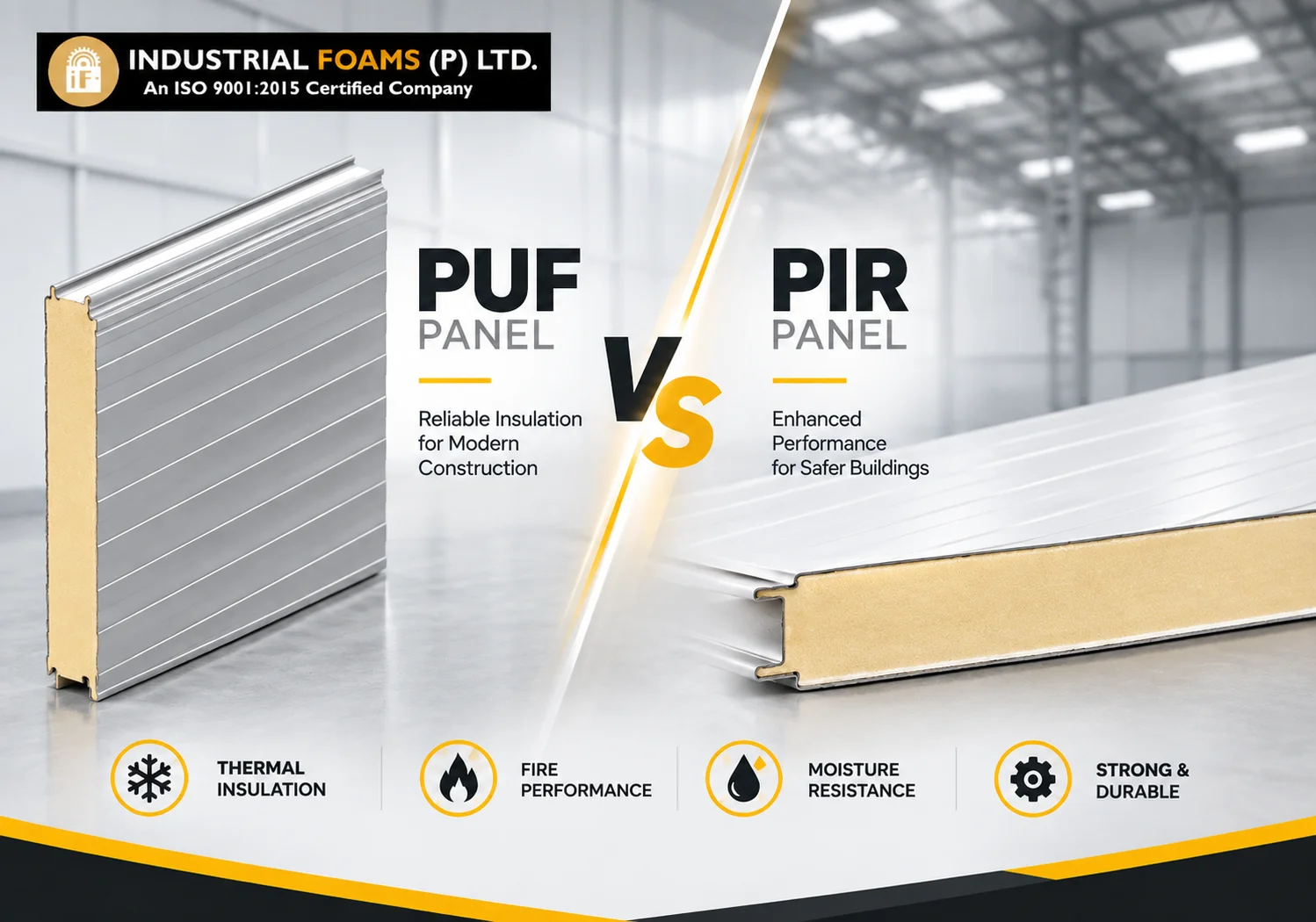
PUF and PIR panels can look almost identical when they arrive at a project site. Both usually combine a rigid foam core with metal facings to create a lightweight, factory-made building envelope. The important difference sits inside the panel. A conventional PUF panel generally uses a polyurethane or PUR core, while a PIR panel uses polyisocyanurate chemistry. That change affects how the foam behaves under heat and fire and can also influence thermal performance, specification options and price.
For most buyers, the decision is not about finding one material that wins every category. It is about matching the tested panel system to the building, temperature range, fire strategy, service life and budget. PUF often remains a practical choice for cold rooms, partitions, portable structures and general industrial insulation where the required performance is clearly defined. PIR is commonly preferred when a project places greater emphasis on fire behaviour or needs a high level of insulation from a relatively thin building envelope.
PIR is usually the stronger option when improved fire behaviour is a central requirement. PUF can be the better commercial choice when standard thermal insulation, fast installation and a controlled initial cost are the main priorities. The final selection should be based on product-specific test reports and the performance of the complete wall or roof assembly, not the core name alone.
What Is a PUF Panel
PUF stands for polyurethane foam. In Indian construction and cold-chain procurement, the term PUF panel commonly refers to a sandwich panel with a rigid PUR foam core bonded between two facings, usually pre-painted galvanised steel, galvanised iron, aluminium or another project-specified sheet. The closed-cell core restricts heat flow and helps the panel resist moisture movement. Because the facings and foam work together, the finished panel can serve as insulation, enclosure and an internal or external finish in one installation.
PUF panels are widely used for cold rooms, refrigerated warehouses, food-processing areas, clean environments, prefab buildings, industrial partitions, roofing and wall cladding. Panel thickness, joint design, foam density, sheet profile and coating are selected for the operating conditions. A panel for a chilled room should therefore not be specified in the same way as a roof panel exposed to sun, wind and rain.
What Is a PIR Panel
A PIR panel is an insulated sandwich panel with a polyisocyanurate foam core. PIR belongs to the same broad family of rigid polyurethane insulation, but it is produced with a higher proportion of isocyanate and a different reaction structure. Under fire exposure, this chemistry is designed to form a more stable char layer and generally slows flame spread and smoke development better than conventional PUR foam. The exact result still depends on the formulation, metal facings, joints, fixings and tested assembly.
PIR panels are used for industrial roofs and walls, temperature-controlled buildings, food and pharmaceutical facilities, logistics centres and other projects where the specification calls for enhanced fire performance. They may cost more than a comparable PUF panel, but that premium can be justified when it supports the project fire strategy, insurer requirements or a thinner thermal envelope.
PUF and PIR Comparison at a Glance
|
Decision factor |
PUF or PUR panel |
PIR panel |
|
Core chemistry |
Rigid polyurethane foam |
Polyisocyanurate foam with a higher isocyanate index |
|
Thermal insulation |
High insulation performance |
Often similar or slightly higher performance for a comparable thickness, subject to product data |
|
Fire behaviour |
Depends on formulation and tested assembly |
Generally better flame and smoke behaviour than conventional PUR |
|
Moisture control |
Closed-cell core with low water uptake when intact |
Closed-cell core with comparable moisture-control benefits |
|
Installation |
Lightweight, prefabricated and quick to install |
Installed using similar panel methods and detailing |
|
Initial cost |
Often lower |
Often higher because of formulation and certification requirements |
|
Typical fit |
Cold rooms, partitions, prefab units and general insulation |
Fire-sensitive industrial envelopes and demanding controlled environments |
|
Selection proof |
Datasheet plus relevant assembly tests |
Datasheet plus relevant assembly tests |
Thermal Performance and Energy Use
Both cores offer strong insulation because their closed-cell structure traps a low-conductivity gas and limits heat transfer. Thermal conductivity is expressed as a lambda value in W per metre kelvin. A lower lambda value means less heat passes through the insulation. The U-value of the complete panel moves in the opposite direction: a lower U-value means the wall or roof assembly loses less heat.
PIR products often deliver a modest thermal advantage over standard PUR at the same thickness, but buyers should compare declared values at the same mean temperature and after the same ageing method. Industrial Foams publishes thermal conductivity values of 0.023 W/mK at a 10 degree Celsius mean temperature and 0.03 W/mK at a 50 degree Celsius mean temperature for its PUR and PIR panel range. That variation shows why a value without test conditions can be misleading.
For cold storage, the correct thickness depends on internal temperature, ambient design conditions, humidity, door openings and the refrigeration load. For an industrial roof or wall, solar exposure, air leakage and thermal bridges at joints and fasteners also matter. A well-specified core cannot compensate for open joints, damaged seals or poorly detailed penetrations.
Fire Performance and Compliance
Fire behaviour is the clearest technical distinction in a PUF vs PIR decision. PIR generally forms a more stable carbonaceous char when exposed to high heat, helping it resist flame spread and reduce smoke compared with conventional PUR. This does not make every PIR panel non-combustible, and it does not mean that a core-only laboratory result proves the performance of a finished building.
Two terms are frequently confused. Reaction to fire describes how a material contributes to ignition, flame spread, smoke and droplets. Fire resistance describes how long a complete building element maintains integrity, insulation and, where relevant, load-bearing capacity. These properties use different test methods. A buyer should therefore ask for the classification or test report that matches the proposed wall, ceiling or roof build-up, including panel thickness, joint, orientation, supports and fasteners.
The project consultant, fire professional and approving authority should define the required performance. Where a specification, insurer or occupancy risk demands non-combustible insulation, neither a generic PUF nor a generic PIR claim should replace an approved mineral-wool or other compliant system. Core chemistry is one input to the fire strategy, not the complete strategy.
Moisture Durability and Hygiene
PUF and PIR cores are predominantly closed-cell and can provide effective resistance to moisture movement when the panel skin and joints remain intact. This makes both suitable for controlled environments, but water performance depends heavily on installation. Vapour pressure can drive moisture through gaps around corners, floor junctions, doors, pipe entries and ceiling suspensions. Condensation may then reduce insulation performance, corrode facings or create hygiene problems.
Cold rooms and food facilities need continuous vapour sealing on the correct side of the envelope, compatible sealants, hygienic finishes and careful detailing at penetrations. Outdoor applications also need a coating selected for humidity, chemicals, salt or industrial pollutants. The panel core should be protected from prolonged exposure during storage and installation.
Strength Installation and Service Life
Both panel types are light relative to conventional masonry envelope systems and can reduce wet work on site. Their spanning capacity, resistance to wind suction and ability to carry maintenance loads depend on the complete panel geometry: core thickness and density, sheet thickness, profile depth, support spacing, fastener pattern and direction of installation. A higher insulation value does not automatically mean a higher structural capacity.
Service life is also determined by details outside the foam. Scratched coatings, exposed cut edges, incompatible fasteners, failed sealants and uncontrolled roof traffic can shorten the life of either panel. Procurement teams should obtain span tables, fixing instructions, coating data and maintenance guidance instead of selecting a panel from core type and price per square metre alone.
Cost and Whole Life Value
PUF panels usually have a lower initial price than PIR panels of a similar size and facing specification. The difference is not fixed. Foam density, thickness, sheet gauge, coating, profile, joint design, order volume, accessories, testing and transport can change the quote. Comparing two rates without aligning these variables often produces a false saving.
A whole-life comparison should include the installed cost, expected energy use, refrigeration or HVAC capacity, compliance documentation, maintenance exposure and business consequences of failure. PIR may offer better value in a high-occupancy facility or a project with stringent fire or insurance requirements. PUF may offer better value for a straightforward cold room or partition when its verified performance already meets the brief. The cheapest panel is rarely the cheapest envelope if it requires extra thickness, creates approval delays or leads to air leakage and rework.
Best Applications for PUF Panels
PUF panels are often well suited to modular cold rooms, chilled storage, freezer enclosures, clean partitions, portable cabins, prefab buildings and standard industrial roofs or walls. They are especially attractive when the project needs reliable insulation, low weight and rapid installation at a controlled capital cost. The designer must still confirm the required thickness, fire classification, load capacity, coating and joint treatment for the actual use.
Best Applications for PIR Panels
PIR panels are commonly considered for manufacturing facilities, warehouses, food and pharmaceutical plants, logistics buildings and temperature-controlled envelopes where improved fire behaviour carries greater weight. They can also help where envelope thickness is constrained and the selected product provides the required U-value at a slimmer build-up. The recommendation remains conditional on certified product and assembly data.
How to Choose Between PUF and PIR
Use the following sequence before requesting a final commercial quote:
- Define the application, including whether the panel forms a roof, external wall, internal partition, cold-room wall, ceiling or door.
- Record the internal and external design temperatures, humidity, washdown regime, chemical exposure and hygiene requirements.
- Set the required U-value or heat-gain limit, then ask the manufacturer to recommend thickness using stated test conditions.
- Obtain the fire requirements from the project consultant and request evidence for the complete panel assembly.
- Confirm span, support spacing, wind load, imposed loads, fastener design and permissible deflection.
- Align the facings, sheet thickness, coating, colour, profile, joint and accessories before comparing prices.
- Review delivery length, unloading, protected storage, installation access and the method for sealing penetrations.
- Compare installed and operating cost, not only the material rate per square metre.
Questions to Ask an Insulated Panel Manufacturer
A useful quotation should identify the proposed core, density, thickness, panel width and length, internal and external facings, metal thickness, coating system, joint type and accessories. It should also state thermal conductivity or U-value with test conditions, dimensional tolerances and available fire documentation. For roofs and external walls, request load-span information and fixing recommendations. For cold rooms, ask how corners, ceilings, floors, doors and service penetrations will maintain the vapour barrier.
Ask whether the fire report covers the offered thickness and installation orientation. Check whether substitutions are allowed after approval, because a change in facing, joint or core formulation may affect the tested classification. Finally, clarify transport limits, unloading responsibility, installation scope, warranty conditions and the process for replacing damaged panels.
Common Selection Mistakes
The first mistake is treating PUF as one uniform product. Formulation, density and factory control differ between manufacturers. The second is choosing thickness from a generic chart without using the project temperature and climate. The third is accepting phrases such as fire retardant or fire rated without a relevant classification and report.
Another common error is comparing a low quote with thinner facings or a basic coating against a more complete specification. Buyers also underestimate joints and accessories, even though air leakage, vapour leakage and water ingress usually begin at interfaces rather than through the centre of an undamaged panel.
A Practical Procurement Example
Consider two quotations for a temperature-controlled warehouse. The PUF option has the lower rate per square metre, while the PIR option offers enhanced fire documentation and a slightly better declared thermal value. The correct decision depends on what the project actually needs. If both options achieve the design U-value, satisfy the approved fire strategy and use equivalent facings, joints and fixings, the PUF option may provide better value. If the PIR construction reduces required thickness, supports an insurer condition or avoids an additional fire-protection measure, its higher material price may lower project risk or total installed cost. Procurement should record these assumptions in a bid-comparison sheet. That makes the award defensible and prevents a cheaper but technically different offer from being treated as an equivalent panel.
Working With Industrial Foams
Industrial Foams Private Limited was founded in 1972 and operates as a polyurethane system house and insulated-panel manufacturer in Greater Noida. Its PUF panel range supports roofing, walling, cold storage, clean environments and prefabricated applications. Buyers comparing PUF and PIR can review the company's PUR and PIR panel specifications and available certifications before finalising the project brief.
For a practical recommendation, share the application, operating temperature, panel area, required thickness or U-value, facing preference, fire requirement, project location and installation scope. The team can then align the panel construction and quotation with the actual duty instead of offering a generic one-size selection. Explore cold room and storage solutions or contact Industrial Foams for a project-specific discussion.
Final Verdict
PIR is generally the better choice when improved fire behaviour and high thermal performance within a limited thickness are important. PUF remains a sound and economical solution for many cold-chain, prefab and industrial applications when its tested performance meets the project requirements. The defensible decision is the panel system that satisfies the thermal, fire, structural, hygiene and durability brief with clear documentation and competent installation.
Frequently Asked Questions
1. Is PIR better than PUF
PIR is generally better for fire behaviour and may provide a thermal advantage at the same thickness. PUF can still be the better commercial choice when a verified PUR panel meets the project requirements at a lower installed cost. Compare product-specific test data rather than relying only on the material name.
2. What is the main difference between PUF and PIR panels
The main difference is the foam chemistry. Conventional PUF panels generally use a rigid polyurethane or PUR core. PIR panels use polyisocyanurate chemistry with a higher isocyanate index, which is designed to form a more stable char when exposed to fire.
3. Which panel has better fire performance
PIR normally performs better than conventional PUR in flame spread and smoke behaviour. However, neither the word PIR nor a core test proves the fire performance of a wall or roof. Request the relevant reaction-to-fire or fire-resistance evidence for the offered assembly.
4. Which panel gives better thermal insulation
Both provide high thermal resistance. PIR often has a similar or slightly lower thermal conductivity than standard PUR, but the result varies by formulation, density, temperature and ageing method. Compare lambda or U-values measured under the same conditions.
5. Can PUF panels be used for cold storage
Yes. PUF panels are widely used in chilled rooms, freezer rooms and refrigerated warehouses. Thickness and joint sealing must be designed around the internal temperature, ambient conditions, humidity, door traffic and refrigeration load.
6. Are PIR panels waterproof
PIR has a closed-cell core and resists water uptake, but an installed panel system is not automatically waterproof. Weather seals, vapour seals, flashings, fasteners, penetrations and undamaged facings determine whether the complete enclosure controls water and condensation.
7. Is a thicker PUF panel better than a thinner PIR panel
It may provide equal or greater thermal resistance, but thickness alone does not settle the comparison. Fire performance, span capacity, joints, sheet specification, available space and installed cost must also be checked. Ask for calculated U-values and assembly data for both options.
8. Why do PIR panels cost more
PIR formulations and the testing or certification associated with demanding specifications can raise the initial price. The premium varies with core density, panel thickness, facings, coating, profile, order size and documentation. A like-for-like quotation is essential.
9. What documents should a buyer request
Request a technical datasheet, thermal values with test conditions, foam density, panel dimensions and tolerances, facing and coating details, load-span data, installation instructions and applicable fire reports. Also confirm that the tested configuration matches the panel being supplied.
10. How do I get an accurate PUF or PIR panel quote
Provide panel area and lengths, application, internal and ambient temperatures, location, roof or wall use, support spacing, facing material and thickness, coating, fire requirement, accessories, delivery schedule and installation scope. Clear inputs reduce exclusions and make competing quotes easier to compare.
Request a Project Specific Panel Recommendation
Choosing between PUF and PIR should begin with the operating conditions and required evidence, not a generic price list. Share your temperature range, application, panel area, fire requirement, facing specification and project location with Industrial Foams. The team can help you compare suitable panel constructions and prepare a quote for your cold room, industrial roof, wall, clean environment or prefabricated structure. Request a quote from Industrial Foams