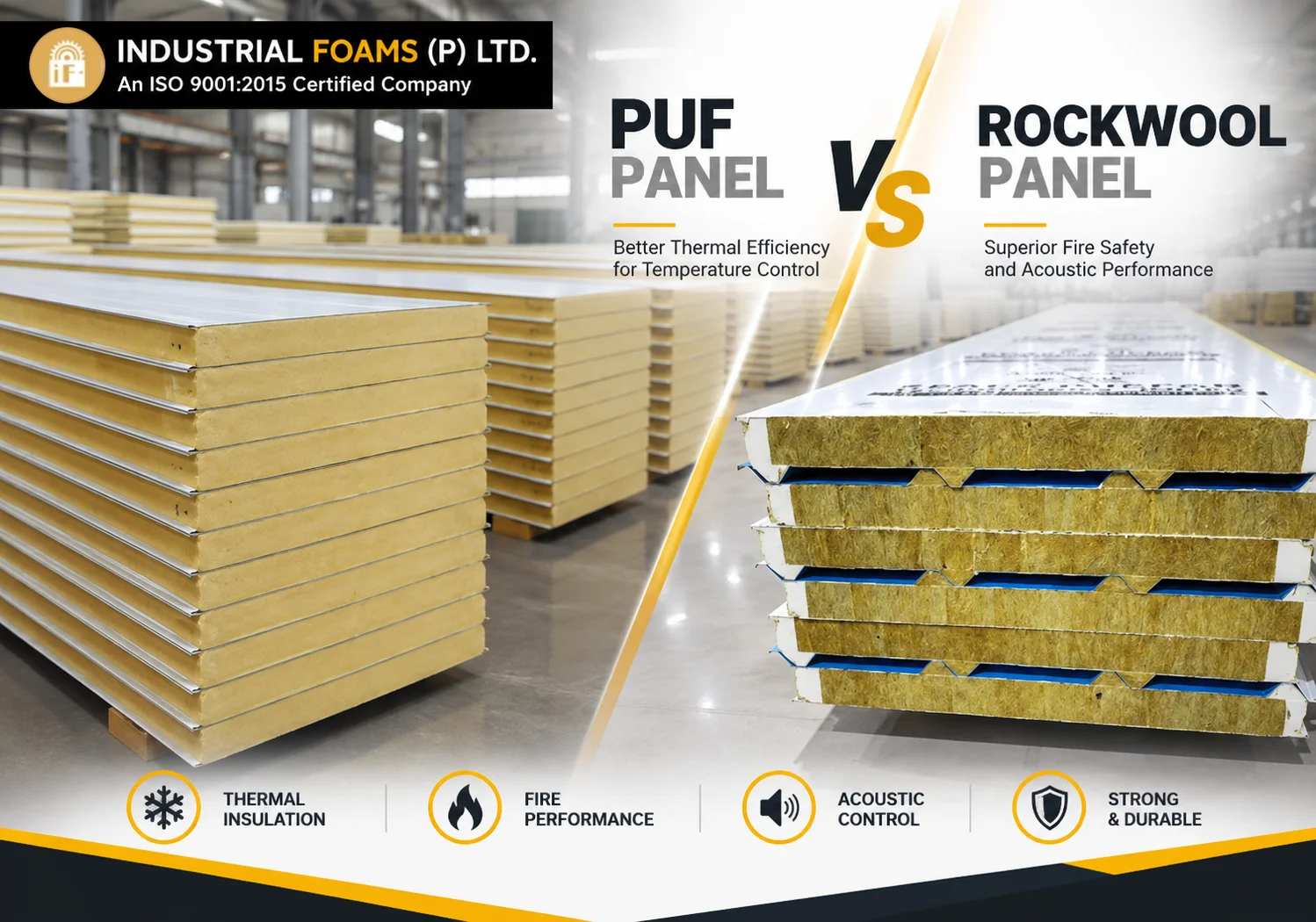
The choice between a PUF panel and a Rockwool panel depends on the risk and performance priorities of the building. PUF panels usually provide more thermal resistance from a slimmer, lighter panel, which makes them a strong fit for cold rooms, freezers, clean rooms and temperature-controlled facilities. Rockwool panels use a non-combustible stone mineral wool core and are commonly selected when fire performance, compartmentation or acoustic control carries more weight than minimum thickness.
Neither option is automatically better for every project. A cold store that loses refrigeration energy through its envelope has a different requirement from a process plant wall designed to separate a higher fire-risk area. The right PUF panel vs Rockwool panel decision comes from matching the complete tested panel system to the building use, temperature range, fire strategy, span, environment and installation conditions. This guide compares the two options from a buyer’s perspective and shows what to request before accepting a quotation.
Choose a PUF panel when high thermal efficiency, low weight, usable internal space and controlled-temperature performance are the main priorities. Choose a Rockwool sandwich panel when a non-combustible core, stronger acoustic absorption or a tested fire-resistance requirement leads the specification. For mixed-risk buildings, the best design may use PUF insulation in temperature-controlled zones and Rockwool panels around fire compartments, escape routes or process areas, subject to the project consultant’s approved fire strategy.
What Is a PUF Panel
A PUF panel is an insulated sandwich panel with a rigid polyurethane foam core bonded between metal facings. The closed-cell core restricts heat flow and helps control water-vapour movement when the joints, seals and penetrations are correctly designed. Because the foam delivers useful insulation at relatively low thickness and weight, PUF panels are widely used for cold rooms, refrigerated warehouses, food-processing areas, clean rooms, prefabricated buildings, wall cladding and insulated roofs.
PUF insulation performance should be read from the offered product data rather than assumed from the name. Industrial Foams publishes, for its PUR and PIR panel range, a core foam density of 44 plus or minus 2 kg per cubic metre and maximum thermal conductivity of 0.023 W per metre kelvin at a 10 degree Celsius mean temperature. Those figures are product-specific reference data, not universal values for every PUF panel. Thickness, foam formulation, ageing, operating temperature, facings and joint quality all affect the final envelope performance.
What Is a Rockwool Panel
A Rockwool panel, often called a rock wool or mineral wool sandwich panel, contains compressed stone-wool fibres between metal sheets. The material is commonly made from basalt or similar mineral raw materials that are melted and spun into fibres. The fibre structure provides thermal insulation and sound absorption, while the mineral core is non-combustible. Industrial Foams lists Rockwool panels for industrial and commercial insulation, acoustic control, walls, ceilings and roofs.
The word Rockwool is often used loosely as a product category, but buyers should still identify the offered manufacturer, core density, fibre orientation, binder, thickness and test classification. A non-combustible core does not mean every assembled wall or roof has the same fire-resistance period. Facings, adhesives, joint geometry, fasteners, support spacing, penetrations and installation determine how the complete panel system behaves during a test and in a building.
PUF Panel and Rockwool Panel Comparison
|
On factor |
PUF panel |
Rockwool panel |
|
Core material |
Rigid, closed-cell polyurethane foam |
Dense stone mineral wool fibres |
|
Thermal efficiency |
Higher resistance at a given thickness in typical panel specifications |
Usually needs greater thickness for a comparable U-value |
|
Fire behaviour |
Combustible core; performance depends on formulation and tested assembly |
Non-combustible mineral core; assembly rating still requires test evidence |
|
Panel weight |
Relatively light |
Heavier because of higher core density |
|
Moisture control |
Closed-cell core resists water-vapour movement when joints stay sealed |
Water-repellent products exist, but wetting and open joints must be prevented |
|
Acoustic control |
Useful enclosure performance, but limited sound absorption |
Generally stronger sound absorption and acoustic control |
|
Installation |
Faster handling and lower lifting load in many projects |
Needs planning for weight, lifting, supports and careful joint closure |
|
Typical uses |
Cold rooms, freezers, clean rooms, controlled-temperature areas, roofs and walls |
Fire-rated walls, plant partitions, high-risk areas, acoustic enclosures and industrial facades |
|
Cost pattern |
Often economical for thermal targets and refrigeration |
Often costs more initially but may satisfy stricter fire and acoustic requirements |
Thermal Performance and Panel Thickness
Thermal conductivity, shown as lambda, indicates how readily heat passes through an insulation material. A lower value generally means better insulation for the same thickness. Rigid polyurethane foam typically has a lower thermal conductivity than stone mineral wool. The Industrial Foams product data cited above lists a maximum of 0.023 W per metre kelvin at a 10 degree Celsius mean temperature for its PUR and PIR foam. Kingspan publishes mineral-wool insulation values in a broader range, and one mineral-wool insulated panel datasheet lists a core lambda of 0.041 W per metre kelvin.
These values should not be treated as a universal head-to-head rating because products, methods and temperatures differ. They do explain why PUF panels can often achieve a target U-value with less thickness. This matters in cold rooms, where every millimetre of wall thickness affects usable storage volume, and in roofs, where lower heat gain can reduce the refrigeration or air-conditioning load. A Rockwool panel can meet demanding thermal targets, but it may need a thicker core and closer attention to joints and thermal bridges.
Ask for declared thermal conductivity, test method, reference temperature and the complete-panel U-value. A quote that gives only an R-value without units or test basis cannot support a dependable insulation panel comparison.
Fire Performance and Fire Resistance
Fire is the clearest technical difference. Stone wool is an inorganic, non-combustible insulation. ROCKWOOL states that its stone wool can resist temperatures above 1,000 degrees Celsius, while Saint-Gobain India describes stone wool as suitable for high-temperature industrial applications and references Indian and international mineral-wool standards. This material behaviour makes Rockwool a natural starting point when the fire strategy calls for a non-combustible core.
Polyurethane foam is combustible. Fire-retardant formulations may reduce flame spread or improve performance, but the term fire retardant is not the same as non-combustible or fire resistant. A fire resistant panel is an assembly that has demonstrated a stated period or classification under a recognised test. The evidence must match the offered panel thickness, orientation, joint, span, facings, fixings and supporting construction. Marketing phrases such as fireproof panel should never replace the test report and approved application details.
Procurement teams should ask what the requirement actually means. Reaction to fire describes how a product contributes to ignition and fire growth. Fire resistance describes how long an element maintains functions such as integrity, insulation and sometimes load-bearing capacity during a standard test. A core classification alone cannot prove the fire resistance of the completed wall. The project fire consultant, authority requirements, insurer conditions and applicable building rules should define the acceptance criteria.
Weight Structure and Installation
PUF panels are comparatively light because rigid foam uses much less material per cubic metre than a dense mineral-wool core. Lower weight can simplify manual handling, reduce lifting demand and support faster installation. It may also allow wider practical spans, although span capacity must come from the manufacturer’s load tables and structural calculations rather than a general material comparison.
Rockwool panels are heavier. The extra mass can support acoustic performance, but it affects transport payload, lifting plans, fixing selection, purlin or girt spacing and installer productivity. Panels must remain protected from site damage and moisture before installation. Crews also need to close joints uniformly and install the specified fasteners without crushing the core or distorting the facings. For either system, poor installation can erase the benefit of a good factory-made panel.
Moisture Vapour and Hygiene
The closed-cell structure of PUF helps resist water absorption and vapour movement. That characteristic is valuable in cold stores, freezers and food facilities, where warm humid air can drive condensation toward colder surfaces. Performance still depends on a continuous vapour barrier. Unsealed joints, damaged facings, poorly detailed floor junctions and service penetrations can allow moisture into the envelope and cause frost, corrosion or loss of insulation performance.
Rockwool products may be manufactured with water-repellent properties, but the core remains fibrous and the panel system must prevent bulk water entry. Roof slopes, laps, sealants, flashings and penetrations need careful detailing. In washdown or hygienic rooms, the internal facing and sealed joint must withstand the cleaning regime; the core name does not establish cleanability. Buyers should specify food-safe or hygienic finishes where required and confirm resistance to chemicals, humidity and cleaning pressure.
Acoustic Performance
Rockwool panels generally offer the stronger option for sound absorption because the fibre network dissipates acoustic energy. They are commonly considered for generator rooms, compressor areas, manufacturing partitions, workshops and buildings near noise-sensitive boundaries. Perforated internal facings can improve absorption in purpose-designed acoustic panels, although they may not suit hygiene or vapour-control zones.
PUF panels can reduce airborne sound as part of a sealed enclosure, but rigid closed-cell foam is not primarily an acoustic absorber. If noise control matters, compare tested sound reduction and absorption data for the complete construction. Junctions, doors, glazing, ventilation openings and gaps often govern the result. A high-performing wall cannot compensate for an untreated louvre or an unsealed door perimeter.
Cost Comparison
There is no reliable single price for PUF panel vs Rockwool panel because quotations depend on panel thickness, core density, steel gauge, coating, profile, span, order quantity, transport distance, accessories, installation height and testing requirements. Market listings may show attractive square-metre prices, but they often exclude flashings, sealants, fasteners, cut-outs, lifting, scaffolding, taxes or installation. A fair comparison uses the same bill of quantities and the same performance scope.
PUF panels are often more economical where the primary target is thermal insulation. Their lower weight can reduce transport and handling effort, and their lower lambda can achieve the required U-value with a thinner panel. For cold-chain projects, the operating-energy effect can be more important than the purchase-price difference. A cheaper panel with weak joints or insufficient thickness may increase refrigeration load for years.
Rockwool panels often carry a higher initial price because the dense core adds material, transport and handling costs. The premium may be justified when non-combustibility, compartmentation, acoustic control or insurer acceptance is essential. Compare total installed cost and compliance value. An offer without the specified test evidence is not technically equivalent.
Applications for PUF Panels
PUF panels are usually the practical choice for applications where heat gain or heat loss must be controlled within a compact envelope. Common uses include cold rooms, freezer rooms, ripening chambers, food-processing spaces, pharmaceutical temperature-controlled rooms, clean rooms, refrigerated warehouses and insulated doors. They are also used in industrial roofs and walls, prefabricated offices, shelters and modular buildings where low weight speeds erection.
Applications for Rockwool Panels
A Rockwool sandwich panel is commonly considered for fire compartments, production-area separations, power and utility rooms, warehouses with a fire strategy, data and electrical rooms, generator enclosures, industrial facades and acoustic partitions. It can also serve roof applications when the tested system, waterproofing details and structural design support that use. Projects with hot processes, combustible inventory or demanding insurer conditions often place greater value on the mineral core.
How to Compare Supplier Quotations
Issue one written specification and require every bidder to identify deviations. At minimum, compare the following items line by line:
- Panel use and location, including internal temperature, humidity, washdown exposure and fire-zone designation.
- Core material, manufacturer, density, thickness, declared thermal conductivity and complete-panel U-value.
- External and internal sheet material, base metal thickness, metallic coating, paint system, profile and colour.
- Joint geometry, sealant, concealed or through fixing, fastener type, flashing gauge and accessory quantities.
- Structural span and load data for wind, roof live load, maintenance access and service deflection limits.
- Reaction-to-fire and fire-resistance reports that match the offered assembly and intended orientation.
- Transport, unloading, lifting, scaffolding, installation, wastage, taxes, warranty and completion schedule.
Request drawings and technical submittals before manufacturing approval. During delivery, record panel identification and inspect facings, edges and dimensions. Keep representative test reports, warranty documents and as-built penetration details in the facility file. These records help future maintenance teams avoid changes that compromise thermal or fire performance.
Which Panel Should You Choose
For cold storage, freezing, clean rooms and other temperature-controlled applications, PUF panels are usually the more efficient starting point because they provide strong insulation with less thickness and weight. For walls or roofs governed by non-combustibility, fire compartmentation or acoustic requirements, Rockwool panels are generally the stronger candidate. Where the project has both needs, divide the building by risk and performance zone rather than forcing one panel across every area.
The final choice should come from approved project criteria and comparable technical offers. Confirm the core, thickness, thermal value, steel facings, coatings, joint, span, fire evidence, accessories and installation responsibility. If two suppliers quote different constructions, normalise the scope before comparing price. That single step produces a clearer commercial decision than relying on claims such as premium, heavy duty or fireproof.
Why Consider Industrial Foams
Industrial Foams Private Limited, founded in 1972 and based in Greater Noida, lists both PUF panel solutions and Rockwool panels for industrial and commercial applications. Its portfolio also includes cold rooms, insulated roofing, prefabricated structures and pre-engineered buildings. This range allows a buyer to discuss the application, envelope details and related construction requirements with one supplier rather than selecting a core from a generic price list.
Frequently Asked Questions
1. Is a Rockwool panel better than a PUF panel
A Rockwool panel is better when non-combustibility, tested fire resistance or acoustic absorption is the leading requirement. A PUF panel is often better when thermal efficiency, lower thickness, lighter weight and refrigeration performance matter most. The building use and approved specification should decide the core.
2. Which panel provides better thermal insulation
PUF insulation generally provides more thermal resistance at the same thickness because rigid polyurethane foam normally has a lower thermal conductivity than mineral wool. Compare declared lambda and complete-panel U-values for the offered products, since test conditions and joint designs can differ.
3. Which panel is safer in a fire
Rockwool has the advantage of a non-combustible mineral core. However, the required fire performance must be proven for the complete wall or roof assembly. Check the applicable test report, thickness, joints, span, facings, fixings and penetrations rather than relying only on the core description.
4. Are PUF panels fire resistant
PUF is combustible, although formulations and complete panel systems can achieve different reaction-to-fire results. Do not equate a fire-retardant claim with non-combustibility or a stated fire-resistance duration. Ask for test evidence that matches the supplied panel and its intended use.
5. Which panel is better for cold storage
PUF panels are usually preferred for cold storage because they deliver high thermal resistance with a relatively slim, light core and support effective vapour control when properly sealed. Freezer thickness should be selected from temperature and heat-load calculations, not from a generic rule.
6. Do Rockwool panels reduce noise
Yes, the fibrous mineral-wool core generally absorbs sound more effectively than rigid PUF. Actual room performance depends on the tested panel, facing type, joints, doors and ventilation openings. Request acoustic data if a specific sound reduction target forms part of the contract.
7. Why do Rockwool panels usually cost more
The dense mineral core increases material weight, transport and handling, while fire-rated assemblies may need specific joints, fasteners and installation controls. The higher initial cost can be justified when it satisfies fire, insurance, acoustic or business-continuity requirements that a basic PUF offer does not meet.
8. What information is needed for an accurate quote
Provide panel area, wall and roof drawings, location, building use, temperature range, core preference, thickness or U-value, fire requirement, sheet gauges, coatings, spans, openings, accessories, installation height and delivery schedule. State whether unloading, lifting, sealants, flashings, taxes and installation must be included.
Final Recommendation
In a PUF panel vs Rockwool panel comparison, the answer follows the project priority. Select PUF for efficient temperature control and a lighter, slimmer envelope. Select Rockwool for a non-combustible core, fire-led specifications and stronger acoustic absorption. For complex industrial facilities, zone the building and use each system where its advantages are relevant. Before placing the order, verify the complete panel construction, test evidence, structural data, accessories and installation scope.
Request a Project Specific Panel Recommendation
Choosing the core is only the first decision. Industrial Foams can review your drawings, operating temperature, fire requirements, spans, facings and installation conditions to help define a suitable insulated panel system. Share your project details with the team and request a technical and commercial proposal for PUF or Rockwool panels based on the actual application, quantities and site location. For more details contact us.