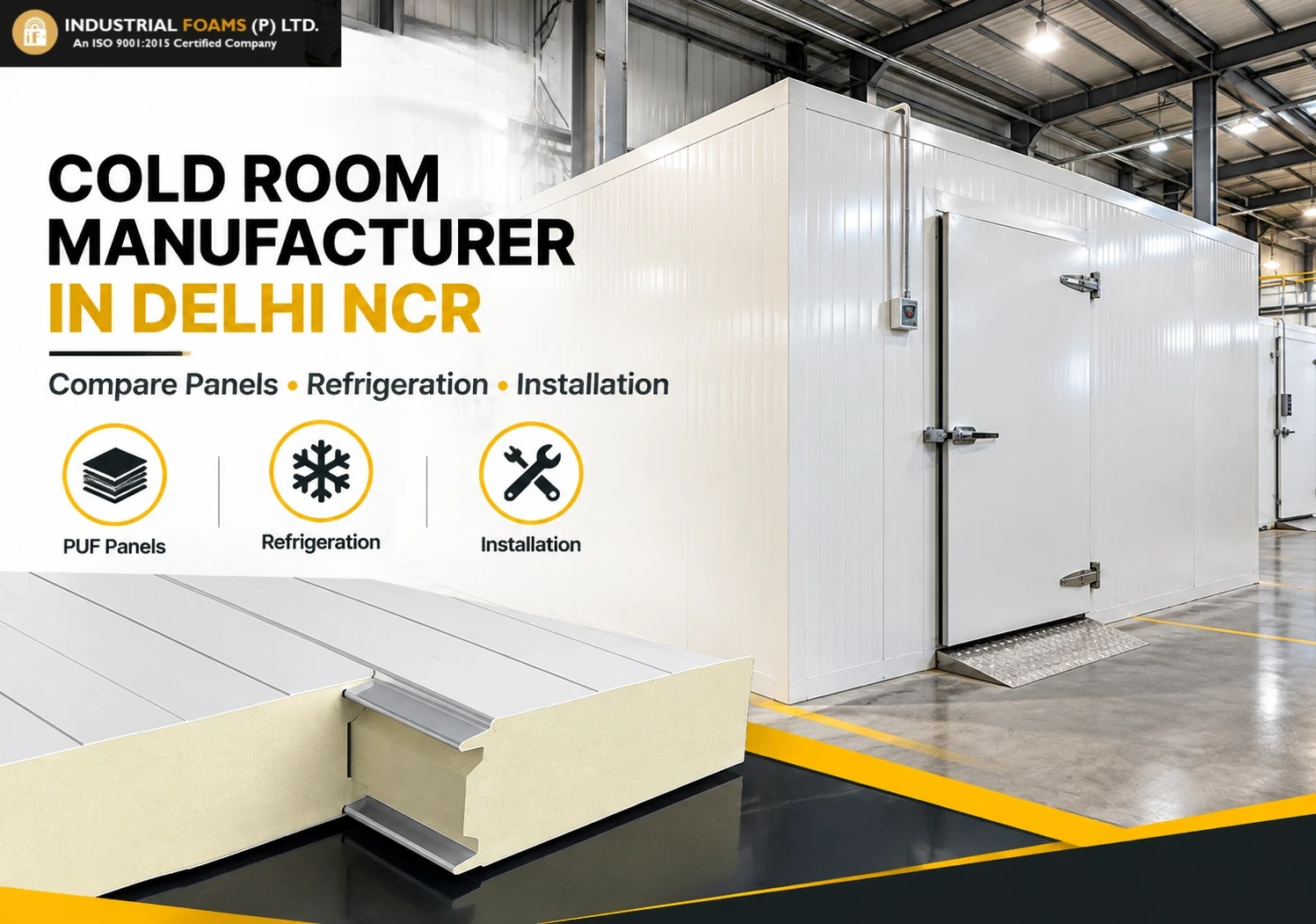
The right cold room manufacturer in Delhi NCR is the supplier that can convert your product load, temperature range, operating pattern and site constraints into a documented thermal envelope, refrigeration duty and installation plan. Buyers should compare design assumptions, panel construction, door performance, refrigeration scope, controls, safety, testing and service—not select only by room dimensions or a quoted price per square foot.
A dependable proposal states what enters the room, how quickly it must cool, how often doors open, ambient conditions, occupancy, electrical supply, redundancy and expansion needs. The manufacturer should identify every inclusion and exclusion and coordinate panels, doors, floor, vapour sealing, equipment and site work. Product quality cannot compensate for an undefined duty or poor installation interfaces.
Start with the Stored Product and Temperature Duty
Different products require different storage temperature, humidity, airflow, pull-down time and hygiene. Fresh produce may need controlled humidity and gentle air movement, while frozen foods require lower temperature and stronger vapour control. Pharmaceuticals or process materials may add mapping, alarm and validation requirements. State the product, packaging, incoming temperature and allowable variation before discussing equipment size.
Separate holding load from pull-down or freezing load. A room that stores already chilled cartons has a different duty from one receiving warm product every day. Include daily throughput, batch size, loading schedule, people, lighting, motors and defrost heat. If the process can change later, identify the future case so the design can reserve capacity without blindly oversizing everything.
| Design input | Effect on cold room | Buyer evidence |
|---|---|---|
| Product and target temperature | Controls refrigeration and hygiene duty | Product storage brief |
| Incoming load and pull-down time | Determines peak cooling capacity | Daily load schedule |
| Door size and openings | Adds infiltration and moisture | Traffic observation |
| Delhi NCR ambient conditions | Affects condenser and panel duty | Site design basis |
| Power reliability | Drives backup and redundancy | Electrical survey |
| Site geometry and access | Controls panel and equipment layout | Measured site plan |
Confirm the Complete Heat-Load Calculation
Cooling load includes heat through walls, roof and floor; warm product; air infiltration; people; lights; fans; defrost and other equipment. Ask each bidder to show assumptions and calculation categories. Quotations cannot be compared fairly when one uses holding duty and another includes aggressive pull-down, frequent door openings and summer ambient conditions.
Review safety margin separately from calculated load. Excessive margin can increase first cost, short cycling and part-load inefficiency, while inadequate capacity causes slow recovery and temperature excursions. If operating data is uncertain, consider staged capacity or monitoring rather than hiding uncertainty inside an unexplained percentage.
Compare PUF PIR and Other Panel Options
Insulated panels form the thermal and vapour envelope. Compare core type, declared density, thickness, facing material, joint geometry, fire performance evidence, dimensional tolerances and production quality. Thermal conductivity values must be tied to a test basis and condition. The suitable panel depends on temperature, span, hygiene, exposure and project fire strategy.
Industrial Foams presents its cold room and storage category and PUF panel range. Buyers should request the exact proposed panel construction and test evidence rather than assuming every product in a broad category has identical thermal, structural or fire properties.
Panel Thickness Is Only One Part of Performance
A thicker core can reduce heat gain, but joints, corners, fasteners, service penetrations and damaged facings can dominate actual performance. Ask for installation details showing how panels lock, how corners are sealed and how thermal bridges are limited. Roof panels also need support spacing and safe access rules; cold room panels should not be treated as a working platform unless designed for it.
Confirm whether the room is positive temperature, chiller, freezer or blast duty. Low-temperature rooms typically require more demanding vapour sealing and floor treatment. Compare panels using complete U-value or thermal-resistance data at stated conditions, not thickness alone. Include expected ageing and surface finish in the lifecycle assessment.
Plan the Floor and Frost Protection
The floor build-up must support racks, pallet trucks, forklifts and concentrated loads while limiting heat gain. Define slab condition, insulation, vapour barrier, wearing surface, hygiene finish and drainage. A freezer may need underfloor ventilation or heating to prevent frost heave, based on ground conditions and design. This is a civil-refrigeration interface and should not be left until panel erection.
Check thresholds and door approaches for impact, drainage and cleaning. Ramps should suit equipment gradients and not create an uncontrolled thermal bridge. Penetrations for drains or services need sealed details. Record floor layers before they are concealed, because later repair can be costly and disrupt operations.
Select Doors for Traffic and Temperature
Door type, clear opening, cycle frequency, seal, frame heater, threshold and protection affect infiltration and usability. Sliding doors can suit larger openings, while hinged doors may serve pedestrian or smaller access. High traffic may justify strip curtains, air curtains, rapid doors or an ante-room, subject to hygiene and process needs.
Industrial Foams lists cold room doors within its range. Ask for door-panel interface details, hardware, release provision, heater load where relevant and spare seals. An oversized or frequently open door can increase refrigeration demand more than a small change in panel thickness.
Evaluate the Refrigeration System Scope
Compare compressor technology, evaporator, condenser, refrigerant, controls, piping, valves, oil management and defrost strategy at the stated duty. Verify rated capacity at the actual room and ambient conditions rather than catalogue nominal conditions. The proposal should show power input, operating range and part-load strategy.
Clarify whether the manufacturer supplies a complete refrigeration package or only the insulated room. If equipment comes from another vendor, establish responsibility for heat-load data, interfaces, commissioning and performance. Check refrigerant compliance, leak management, ventilation and safety requirements with qualified specialists and applicable rules.
Air Distribution Defrost and Moisture
Evaporator placement should circulate air across the room without drying sensitive product, creating warm corners or blowing directly into an open door. Racking and loading height affect airflow. Require clearances and a loading plan. Commissioning should verify room temperature at representative points rather than reading only the controller sensor.
Defrost method and schedule must remove ice without excessive heat or water problems. Provide drain trays, heated drains where necessary, proper slope and accessible cleaning. Moisture entering through doors or panel leaks can freeze on coils and floors. Address the source rather than treating repeated ice removal as normal maintenance.
Controls Alarms and Temperature Records
Specify controller functions, sensor quantity and location, high and low alarms, door alarms, power-failure alerts, remote communication and data retention. Critical stores may require independent monitoring and calibrated sensors. Define who receives alarms and how they respond outside working hours; a connected alarm without an escalation plan is not protection.
Separate control sensors from verification or mapping sensors when the quality plan requires it. Record setpoints, alarm limits, delays and access levels at handover. Back up controller settings. Any claim of compliance or validation should be tied to the client’s industry and approved protocol rather than a generic cold-room certificate.
Electrical Supply Backup and Energy Use
Confirm connected load, starting current, distribution, cable route, earthing, protective devices and emergency isolation. Delhi NCR sites can experience voltage or power constraints, so identify generator, UPS or redundant refrigeration requirements according to product risk. Backup should support essential controls and cooling for the required duration, not just lighting.
Compare annual energy drivers: room temperature, ambient, door traffic, panel performance, compressor efficiency, fan control, defrost, condenser condition and setpoint discipline. Request expected power at defined conditions and avoid guaranteed savings without measurement boundaries. Sub-metering can reveal deteriorating performance and support preventive maintenance.
Hygiene Materials and Cleaning Access
Food, dairy, pharmaceutical and hospitality projects may need washable finishes, sealed joints, coved corners, controlled drains and pest-resistant details. State cleaning chemicals and temperatures so panel coatings, sealants and floor finishes can be checked for compatibility. Avoid ledges and inaccessible gaps that collect debris.
Plan access around evaporators, drains, doors, condensers and control panels. Maintenance should not require product contamination or unsafe work over racks. If washdown is expected, verify electrical enclosure suitability and water management. Hygiene requirements should appear in the specification and inspection checklist, not be assumed from white surfaces.
Compare Manufacturer Capability and Responsibility
Assess design competence, panel production or sourcing, refrigeration integration, installation team, project management, quality records and service capacity. Ask who signs the load calculation, who coordinates civil work and who owns final performance. A local office alone does not prove manufacturing or emergency support, while a distant factory may still provide effective service through a structured network.
Industrial Foams identifies facilities in New Delhi and Greater Noida on its contact page. Buyers should verify the current point of contact, proposed production location, lead time and site team for their order. Visit a representative installation or factory when project risk justifies it, and record observations against the same evaluation checklist used for all bidders.
Normalize Quotations Before Price Comparison
Create a comparison sheet for room dimensions, design temperatures, ambient, load, panels, floor, doors, refrigeration, controls, electrical scope, transport, installation, testing, warranty and maintenance. Separate taxes, civil works, craneage and utilities. A cheaper quote may omit floor insulation, frame heaters, controls, drain work or commissioning.
Require a deviation schedule and make bidders price the same duty. Compare delivery and installation sequence with site readiness. Payment milestones should follow measurable deliverables such as approved drawings, material dispatch, erection, testing and handover. Keep provisional items visible instead of hiding them inside lump-sum rates.
| Bid area | Compare | Typical hidden gap |
|---|---|---|
| Thermal envelope | Core, thickness, facing, joints and floor | Floor or corner details omitted |
| Refrigeration | Capacity conditions and full component list | Nominal duty only |
| Doors | Size, traffic controls, hardware and heaters | Accessories priced separately |
| Controls | Sensors, alarms, logging and remote access | Basic thermostat only |
| Installation | Civil, electrical, drains and lifting | Interface responsibility unclear |
| Handover | Testing, training, warranty and service | Documentation not included |
Installation Quality and Hold Points
Approve shop drawings and material data before production. At site, verify slab, dimensions, access and utilities before panels arrive. Establish hold points for floor layers, vapour sealing, panel joints, roof suspension, service penetrations, refrigeration pressure testing and electrical checks. Photograph concealed work with location references.
Protect panels from moisture, scratches and impact during storage and erection. Use approved cutting and sealing methods; uncontrolled holes can damage the vapour envelope. Coordinate piping and cable supports so they do not overload panels. Close gaps immediately rather than relying on a final cosmetic sealant pass.
Commissioning Performance and Handover
Commissioning should include visual inspection, pressure and leak tests, evacuation records, electrical tests, controller functions, defrost, drains, door operation, alarms and a temperature pull-down or stability test under agreed conditions. Compare results with the design duty and document any unloaded-test limitation.
Provide as-built drawings, panel and equipment data, refrigerant record, controller backup, calibration evidence where required, test sheets, warranty, spares list, training and preventive-maintenance schedule. The operating team should understand loading limits, door discipline, alarm response and safe isolation before product enters the room.
Common Supplier Selection Mistakes
Common mistakes include comparing only room volume, accepting compressor horsepower as a capacity calculation, ignoring incoming product temperature, omitting floor insulation, selecting doors without traffic data and assuming every white panel is hygienic. Another mistake is splitting panel and refrigeration packages without assigning integration responsibility.
Avoid unverifiable rankings, fixed price-per-square-foot promises and guaranteed temperature claims that omit ambient, load and operating conditions. The strongest quotation makes assumptions visible, resolves interfaces and defines acceptance. If requirements change, revise the calculation and drawings rather than asking the installer to improvise.
Delhi NCR Site and Logistics Considerations
Delhi NCR projects may involve congested access, restricted delivery hours, dust, high summer ambient, monsoon exposure and limited plant-room space. Survey the route for panel lengths, condensing units, cranes and unloading. Confirm whether work occurs in an operating food, pharma, retail or logistics facility and define segregation, permits and shutdown windows.
Sequence civil readiness, floor work, panels, refrigeration, electrical services and commissioning so unfinished work does not damage the vapour envelope. Store panels dry and supported. Protect operating areas from dust and debris. Local proximity can help coordination, but the contract should still state response times, personnel, equipment and responsibility for municipal or site permissions.
Redundancy and Business Continuity
The required redundancy depends on product value, permissible temperature excursion, repair time and alternative storage. Options include multiple compressors, duty-standby equipment, spare controllers, backup power or an emergency transfer plan. Redundancy should remove credible single failures without creating controls that are too complex to operate.
Define the response to compressor, fan, sensor, door, power or communication failure. Keep emergency contacts and decision thresholds available to every shift. Test alarm escalation and backup changeover during commissioning. A spare machine that has never been started or a generator without sufficient refrigeration capacity is not dependable continuity planning.
Maintenance Access and Lifecycle Cost
Provide service clearance around compressors, condensers, evaporators, valves, drains and electrical panels. Filters and coils should be cleanable without dismantling unrelated equipment. Position isolation valves and test points logically, and protect equipment from vehicle impact. Roof or high-level equipment needs safe access and lifting provisions for replacement.
Compare lifecycle cost through energy, planned maintenance, refrigerant management, door seals, sensors, spare parts and expected disruption—not only purchase price. Ask for a recommended spare list and maintenance intervals. Review availability of technicians and major components. A technically efficient system can still create costly downtime if routine service is unsafe or parts are unidentified.
Frequently Asked Questions
1. What should I give a cold room manufacturer for a quotation?
Provide product, incoming and storage temperatures, daily load, pull-down time, room size, door traffic, ambient, site plan, power and required standards.
2. Is cold room capacity based only on room volume?
No. Product load, infiltration, ambient, insulation, people, equipment and pull-down duty all affect capacity.
3. Which panel thickness is best for a cold room?
It depends on temperature, core performance, joints, span, fire strategy and lifecycle goals; there is no universal thickness.
4. Do I need floor insulation?
Many chilled and freezer rooms require it, but the build-up must follow temperature, loads, ground and frost-heave assessment.
5. How should two supplier quotations be compared?
Normalize design conditions, panel and floor scope, refrigeration capacity, doors, controls, installation, testing and exclusions.
6. What is the difference between holding and pull-down duty?
Holding maintains already cooled product; pull-down removes heat from warmer incoming product within a specified time.
7. Should a cold room have remote alarms?
Critical stores often benefit from them, but recipients, escalation, communications and power backup must also be planned.
8. Why do cold room doors affect energy use?
Openings admit warm humid air, adding sensible and latent load and increasing frost and defrost demand.
9. What documents are needed at handover?
As-built drawings, calculations, equipment data, tests, refrigerant records, controller settings, warranty, training and maintenance plans are typical.
10. Can panels support people walking on the roof?
Only if the system is specifically designed and approved for that load with safe access provisions.
11. How is temperature performance verified?
Use an agreed commissioning or mapping method with suitable sensors, test conditions, duration and acceptance limits.
12. What service support should buyers confirm?
Confirm response process, preventive maintenance, refrigerant and spare availability, remote support and warranty exclusions in writing.
Choose a Cold Room Partner Who Makes Performance Measurable
A reliable cold room purchase begins with transparent design inputs and ends with recorded performance, trained operators and maintainable equipment. Issue the same thermal and scope brief to every bidder, compare deviations and insist on coordinated panel, refrigeration and site interfaces. Review Industrial Foams’ company information and contact its team through the official enquiry page for a duty-based cold room proposal in Delhi NCR.